




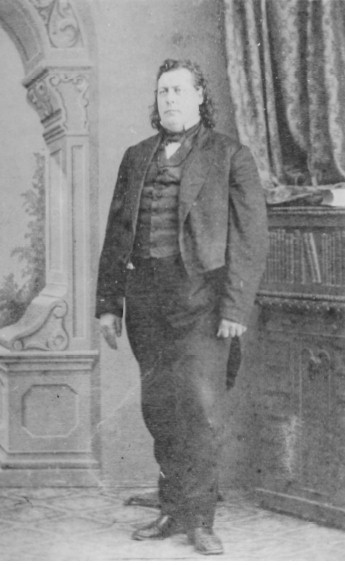
Ward Hill Lamon
Lincoln and His Marshal
They snuck into the city. Abraham Lincoln, soon to be inaugurated President of the collapsing Union, arrived unannounced in Washington, D.C., early on the morning of February 23. 1861, nine days before his March 4 inauguration. Ward Hill Lamon, soon to be commissioned the United States Marshal for the District of Columbia, accompanied the President-elect. He acted as Lincoln's personal bodyguard while Allan Pinkerton and his detectives provided general security. Armed with a brace of pistols and a Bowie knife, Lamon was determined to prevent any trouble from his fellow Southerners. A Virginian by birth, the future marshal was Lincoln's friend and business associate. They had known each other for 20 years. While Lamon devoted himself to serving and protecting the Yankee president, his mother and brothers transferred their loyalty to the south.
Lamon watched with dismay as the federal experiment soured over the election of his friend. He urged the new president to distribute "circulars of appeal" to the Southern people "to stand by the flag, to stand by the Union." Desperate for some way to stop the Southern states from seceding. Lamon also recommended that the new president complete the construction of the Treasury Building. Such an action, Lamon felt, would prove to the South and most foreign nations "the confidence of the U.S. sustaining herself and will give at the same time many idlers employment, thereby identifying them to some extent with the government." Yet, rebuilding the Treasury building was hardly enough to keep the Union together. The suggestion reflected Lamon's desperation as state legislatures throughout the South passed resolutions of secession.
Federalism failed.
South Carolina withdrew from the Union first. The state legislature passed its declaration of secession on December 20, 1860, less than two months after Lincoln's election. Having announced its separation from the other states, it demanded that Union forces withdraw from its territory. In the middle of Charleston harbor, Major Robert Anderson and his command refused to evacuate Fort Sumter. A stalemate ensued when South Carolinian troops besieged the island fort. At the end of March 1861, Marshal Lamon hurried from Washington to South Carolina. Although he assured Governor Thomas Pickens that he was acting privately, without charter from Lincoln, that is doubtful. The President at least knew of Lamon's intentions and probably gave his blessing to the mission.
Lamon obtained a pass from Governor Pickens allowing him to cross through the besieging forces and talk with Major Anderson. The governor sent his aide, Colonel Duryea, with Lamon to ensure "that every propriety is observed."
Returning from Fort Sumter, Lamon again met briefly with the governor. He urged Pickens to allow Anderson and his men to evacuate the fort unharmed. Pickens decided against Lamon's advice. At 4:30 a.m. on April 12. 1861, the South Carolina forces began bombarding the fort. After withstanding the cannonade for 34 hours, Major Anderson surrendered his command on the afternoon of April 13. The Civil War, the supreme test of the federal system of government, had begun.
Worried that his contribution to the war as U.S. Marshal would not be enough, Ward Hill Lamon decided to do more. On the morning of April 22. 1861, he renewed his oath to "support, protect and defend" the Constitution. In the summer of that first year of war. Lamon began enlisting army volunteers among loyal Virginians. He hoped to form a "Virginia Brigade" to fight in the Union Army. President Lincoln supported the plan and Secretary of War Simon Cameron authorized Lamon to draw on the Union Army for arms. ammunition, and other supplies. Although Lamon hoped to find volunteers among loyal Virginians, that proved difficult because of the "demoralization of the people there" over Union defeats. In September 1861, he traveled to Pennsylvania and Illinois enlisting recruits. He returned with a command of seven hundred men. Early in the war, the "Virginia Brigade," as Lamon insisted on calling it, guarded the forts along the Potomac River. Lamon wore the rank of brigadier general. but he also retained his commission as U.S. Marshal. In addition to his other responsibilities.
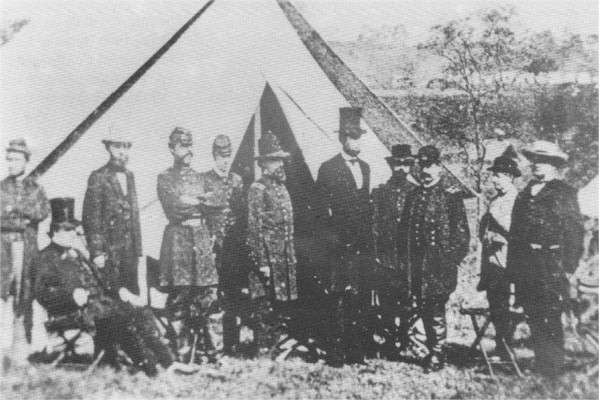
Lamon took upon himself the difficult task of protecting Lincoln, who had no patience with protective measures. One story has it that on the night of Lincoln's inauguration Lamon slept, with pistols and Bowie knife, on the floor outside the new president's bedroom, his large body stretched in front of the door. The marshal also accompanied Lincoln on many of the president's trips. In November 1863, for example, Marshal Lamon escorted the President to Gettysburg, Pennsylvania, where Lincoln dedicated the new Union cemetery.
As God is my judge, I believe if I had been in the city, it would not have happened and had it, I know the assassin would not have escaped the town.
Lincoln objected to Lamon's constant efforts to protect him. A fatalist, the President shrugged off the idea that someone would kill him. "He (the President) thought me insane upon the subject of his safety," Lamon remembered in late April 1865, "and that I had been for the past four years insanely apprehensive of his safety." Even after attempts had been made on Lincoln's life, the President made little effort to protect himself.
On Thursday, April 13, 1865, Lincoln sent Marshal Lamon to Union-occupied Richmond. At their final interview before Lamon's departure, the marshal begged the President to take care. The next day, Lincoln accepted an invitation to attend Laura Keene's one thousandth performance in Our American Cousins. John Wilkes Booth, who truly was insane over Lincoln's safety, also made a brief. and wholly tragic, appearance at Ford's Theater that night.
"As God is my judge," Lamon lamented. "I believe if I had been in the city, it would not have happened and had it, I know that the assassin would not have escaped the town." After Lincoln's assassination, Lamon performed one last duty for his murdered friend. He and his deputies arranged the last rites, taking Lincoln's remains home to Springfield for the funeral. Less than two months later, Lamon resigned his commission as United States Marshal for the District of Columbia.
Excerpt from Frederick S. Calhoun, United States Marshals and Their Deputies, 1789-1989