




The Judiciary Act of 1789: Charter for U.S. Marshals and Deputies
Senate Bill Number One of the First Session of the First Congress became, after lengthy and heated debate, the Judiciary Act of September 24, 1789. The Act provided a charter for the federal judicial system by specifying the jurisdiction and powers of the district and circuit courts, and the qualifications and authority of federal judges, district attorneys, court clerks, U.S. Marshals, and Deputy Marshals. Invited by Article III, Section 1, of the newly ratified Constitution to "ordain and establish" a court structure for the new national government, the first Senate moved quickly to the task. But its labors were immediately embroiled in a bitter contest between the Federalists, who wanted a strong federal government, and the Anti- Federalists, who jealously guarded the rights of the states.
The result was a typically American compromise. The Federalists stymied an Anti-Federalist motion to limit the district courts' jurisdiction to admiralty and maritime cases only. The Anti-Federalists succeeded in limiting the appellate review of federal courts to issues of law, excluding questions of fact. The final form of the Act satisfied neither side, for most of the participants recognized it as a clumsy, inefficient system. As soon as the Act passed, the Congress directed the Attorney General to report on ways to improve it. Yet, the judicial system's very clumsiness and inefficiency has served it well in successfully achieving its contradictory purposes of exerting federal authority while protecting the rights of the states and the freedoms of individual citizens. In governing ourselves, we Americans have never had an easy time determining how much or how little government we wanted. Our system of federal courts accurately reflects this fundamental indecisiveness.
From this perspective, we can better understand the difficult tasks that generations of Marshals and Deputies have confronted as they tried to enforce the law upon a people who, while recognizing the necessity for law, have never been comfortable with any encroachment on their personal liberties:
This article briefly describes the origins of the office of Marshal in the Judiciary Act of 1789. The theme explored here runs consistently throughout the history of the Marshals Service. For 195 years, Marshals and Deputies have performed the duties originally assigned them by the Judiciary Act of 1789. Their history is also the story of a nation's unending attempt to balance the need for law and order against the demand for individual freedom and the rights of the states.
- Part 1–The Authors of the Judiciary Act of 1789
-
The history of the federal court system began on April 7, 1789, the second day of business for the first Senate. On that day, the members appointed a Special Judiciary Committee to formulate a judiciary act for the United States. Each of the 10 states then represented in the Senate (New York had not held its elections for Senators and Rhode Island and North Carolina had yet to ratify the Constitution) was given one seat on the Special Committee. Of the 10 members, half had been delegates to the Constitutional Convention of 1787.
This impressive roster of Senators included Oliver Ellsworth of Connecticut, who had coined the name "Government of the United States." and William Paterson of New Jersey, who was the author of the famous "New Jersey Plan" in the Constitutional Convention. A few of the other members were Caleb Strong of Massachusetts, one of the leading Federalists of the day; William Maclay of Pennsylvania, a crotchety independent plagued by rheumatic knees, but alive with a strong protective feeling toward the rights of individual citizens; and Richard Henry Lee, who had introduced the resolution declaring American independence in the second Continental Congress on July 2, 1776.
The actual work of writing the judiciary bill fell primarily to Ellsworth and Paterson, with some assistance from Strong. Because sections of the original bill are in the handwriting of the authors, we know for certain that Paterson penned the first nine sections, which dealt primarily with the mechanics of the judicial system, such as the number of federal districts, the establishment of district and circuit courts, the office of court clerks, and the time for the opening session of the courts.
Ellsworth wrote sections 10 through 23, which were the heart of the bill since they covered the scope of authority of the courts, the original jurisdiction of the Supreme Court, the right to issue writs, the various methods of appeal, and the type of writs of error. These sections were the most controversial and the most heavily amended by the Senate. The remaining 20-odd sections of the original bill, including the two sections on Marshals and Deputies, are not in any identifiable handwriting, which indicates that they were recorded by one of the clerks of the Senate.
- Part 2–The Authors of the Judiciary Act of 1789
-
Since the first 23 sections of the bill were clearly the most controversial, Ellsworth and Paterson probably continued to work on them up to the last minute before the bill was introduced in the Senate on June 12. The remaining sections were probably written early enough to be handed over to one of the clerks for transcription into the formal script of the day. A preponderance of the evidence, however, points to Ellsworth as the principal author of the bill. The comments of his contemporaries in the Senate, as well as the conclusions of later historians, attribute him with most of the work of authorship.
Maclay, for example, noted in his journal that the bill was a "children of Ellsworth's, and he defends it with the care of a parent, even with wrath and anger." Senator Paine Wingate of New Hampshire, who was on the Special Judiciary Committee, called Ellsworth "the leading projector" of the Bill, and Charles Warren; who wrote the definitive legislative history of the Act; concluded that Ellsworth was the main author.
Ellsworth was born in Windsor, Connecticut, on April 29, 1745, and died in the same town on November 26. 1807. His had a long and illustrious career, intimately entwined with the formation of' the new nation. He attended Yale for two years before transferring to the College of New Jersey (which later changed its name to Princeton), where he graduated in 1766 with a Master of Arts degree. For the next several years, Ellsworth read the law before being admitted to the Connecticut bar in 1771.
Six years later, he was elected to the Continental Congress, serving throughout the Revolutionary War until 1783. In 1784, he sat on the Connecticut Supreme Court of Errors, moving at the end of the year to the Connecticut Superior Court. As a delegate to the constitutional Convention in 1787, he helped formulate the 'Connecticut Compromise," which gave to each state equal representation in the Senate. It was during the Convention that Ellsworth proposed the name "United States" for the new country, which was quickly adopted by his colleagues.
- Part 3–The Authors of the Judiciary Act of 1789
-
As one of Connecticut's first two senators, Ellsworth took an active part in the work of building the new government. He was a committed Federalist intent on establishing broad powers for the federal government. In addition to writing the Judiciary Act of 1789, he formulated the first set of Senate rules; he reported from committee the first 12 amendments to the Constitution (which included the Bill of Rights); he framed the measure admitting North Carolina to the Union; and he devised the boycott that eventually forced Rhode Island to ratify the Constitution.
In 1796, George Washington appointed him Chief Justice of the Supreme Court, the second man to fill that seat. In 1800, he negotiated a treaty with France to avert a war between the United States and Napoleon Bonaparte. Poor health forced Ellsworth to retire from public service after this diplomatic mission.
William Paterson, the second author of the Judiciary Act, was born in County Antrim, Ireland, on December 24, 1745. He died in Albany, New York, on September 9, 1806. Paterson's parents emigrated to the colonies in 1747, where they made their home in New Jersey. Like Ellsworth, Paterson also graduated from the College of New Jersey with a Master of Arts degree before reading for the law and gaining admittance to the New Jersey bar in 1769. He declined election to the Continental Congress in 1780, preferring, instead, to carry out his duties as attorney general of New Jersey.
He accepted election to the Constitutional Convention in 1787. Paterson's opposition to the Virginia Plan" of electing representatives on the basis of a state's population led him to formulate the 'New Jersey Plan." This plan proposed three branches for the federal government, but with a unicameral legislature composed of equal numbers of representatives from each state. Elected one of New Jersey's first senators, Paterson helped draft the Judiciary Act, but he left the Senate to become Governor of New Jersey.
Washington appointed him an Associate Justice of the Supreme Court in 1793. His duties on the court included presiding over the trial of some of the rebels who were indicted for treason during the Whiskey Rebellion of 1794. Thus, the two authors of the Judiciary Act of 1789 were prominent men of their day who served the new nation with distinction. Each was a committed Federalist intent on ensuring a strong federal government to unite the thirteen disparate colonies.
Although they never achieved the fame gained by their colleagues Washington, John Adams, or Alexander Hamilton, their influence was no less important. The Judiciary Act was but one of the many significant contributions that both Ellsworth and Paterson made in the early history of the United States.
- Passage of the Judiciary Act
-
Ellsworth, Paterson, and the other members of the Special Judiciary Committee worked a little over two months drafting the judiciary bill. Richard Henry Lee introduced the measure in the Senate on June 12. Oddly enough, Lee later voted against the bill after unsuccessfully proposing an amendment to limit the jurisdiction of district courts to admiralty and maritime cases. At the same time that the Congress considered the bill, it also debated the first 12 amendments to the Constitution. Consequently, the final form of the Act was shaped by the limits on federal power imposed by the Bill of Rights.
Although Ellsworth considered the bill "a proper arrangement of the Judiciary," others were not so enthusiastic. James Madison, a Congressman from Virginia, viewed it as "defective both in its general structure, and many of its particular regulations. Senator William Grayson, also of Virginia, called the Act "monstrous." Another Senator concluded it was "defective in point of arrangement," as well as "obscurely drawn or expressed." But few surpassed William Maclay in disgust over the bill. "It was fabricated by a knot of lawyers," he complained, "who joined hue and cry to run down any person who will venture to say one word about it." On July 17, he noted in his journal that "it certainly is a vile law system, calculated for expense and with a design to draw by degrees all law business into the Federal courts.
The Constitution is meant to swallow all the State Constitutions by degrees, and thus to swallow, by degrees, all the State judiciaries." Maclay's main objection to the bill centered on the lack of provision for juries in equity cases before circuit courts. Claiming that this resembled too closely the chancery courts at the county level, he tried on several occasions to amend the bill to allow for juries, but his efforts ultimately met defeat. Other Senators had better luck in changing the bill.
Although the scope and number of these amendments lie beyond the reach of this article, the general focus of the revisions was to limit the powers of the federal government over the rights of the states, yet to leave the national government powerful enough to conduct its business. As Warren concluded in his legislative history of the Act, its final form "was a compromise measure so framed as to secure the votes of those who, while willing to see the experiment of a Federal Constitution tried, were insistent that the Federal Courts should be given the minimum powers and jurisdiction."
After extensive debate, the bill was approved by the Senate on July 17, 1789, by a vote of 14 to six. Three of the ten members of the Special Judiciary Committee voted against the bill, including Lee, Maclay, and Wingate. They were joined in opposition by Grayson, John Langdon of New Hampshire, and Pierce Butler of South Carolina.
The House took up the bill on July 20, but its consideration was delayed almost six weeks because of the debates over the first 12 amendments to the Constitution. Eventually, the House suggested at least 52 amendments to the judiciary bill, but most of these changes were minor in nature. All but five were accepted by the Senate. On September 21, Congress approved the Judiciary Act and Washington signed it into law on September 24.
- Recognition of the Need for Federal Marshals
-
To a remarkable extent, the sections of the judiciary bill pertaining to Marshals and Deputies escaped the attacks and amendments of the bill's opponents. Although the passage of time, combined with extensive water damage, has rendered portions of the original bill illegible, it is clear that the sections on the Marshals underwent no significant amendment.
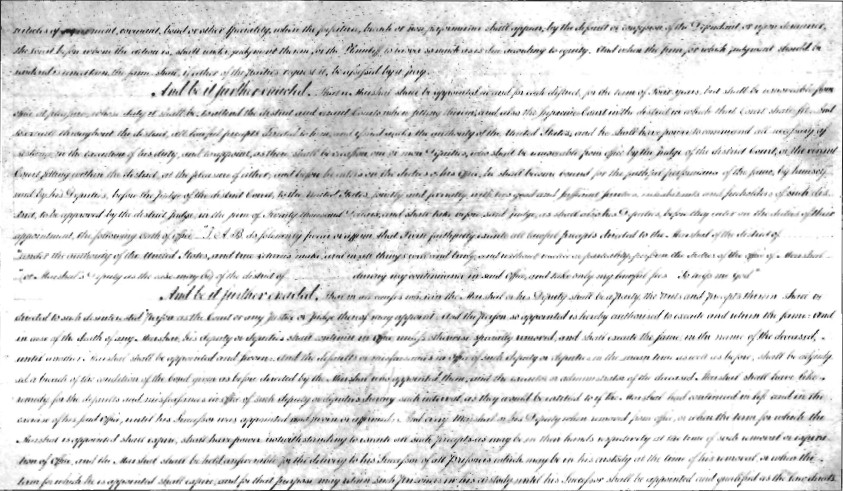
This shows the two sections of the Judiciary Act of 1789 that outlined the office and functions of the U.S. Marshals and Deputy Marshals. Other sections of the bill were extensively revised before the Senate approved it. For example, the original bill called on each district court to appoint "a meet person learned in the law, to act as Attorney of the United States in such district."
The original bill assigned the justices of the Supreme Court the task of selecting "a meet person learned in the law to act as Attorney General for the United States.. . whose duty it shall be to prosecute and conduct all suits in such Courts in which the United States shall be concerned and to give his advice and opinion upon questions of law when required by the President of the United States and when requested by the Heads of any of the Departments, touching any matters that may concern their Departments."
As finally passed, the Judiciary Act was silent on designating who would appoint the District Attorneys and the Attorney General, as well as U.S. Marshals. This void was quickly filled by President Washington, who was ready with a list of appointees on September 30.
Two plausible reasons help explain the passage of the sections pertaining to Marshals and Deputies substantially as they were originally written by Ellsworth and Paterson. First, the need for some kind of enforcement authority was widely recognized and generally accepted, even by the Anti-Federalists. It would have made no sense to pass laws without provision for their enforcement.
The Judiciary Act assigned this task to the Marshals. The language of the assignment was so broadly written that few could find reason to challenge it. The Act instructed the marshal of each district "to execute throughout the District, all lawful precepts directed to him, and issued under the authority of the United States." To assist him in his duties, each Marshal was allowed to appoint Deputies and "to command all necessary assistance in the execution of his Duty."
The role of the federal Marshal was clearly modeled on the county sheriff. Since most of the legislators of 1789, including the authors of the judiciary bill, were lawyers, it is not surprising that they would use their state or counties as examples in defining the role of Marshals. Prior to independence, each of the American colonies had established a system of local courts served by sheriffs appointed by the royal governor (except in Pennsylvania, where sheriffs were elected). According to David Hawke in The Colonial Experience, "the sheriff became the ranking police and financial officer of the county.
He served warrants and made arrests. He collected taxes, the minister's dues, the king's or proprietor's quitrents, and fees owed the governor, secretary, or clerk of the court. He got 10 percent of all he took in." In Virginia, from 1619, when the colony was founded, until about 1634, local sheriffs were actually called provost-marshal or marshal.
They were paid assigned fees in pounds of tobacco for such duties as collecting fines, taking inventory of a deceased person's estate, and apprehending and transporting all felons to Jamestown. Similarly, as soon as the colony of Georgia was founded in 1733, the office of provost marshal was established and lasted until as late as 1773.
- Recognition of the Need for Federal Marshals (continue)
-
Thus, at the local level, the office of law enforcer - sheriff - was well established by 1789. Although it is not clear why the Senate selected the name "Marshal" instead of "federal sheriff" or some other derivative, it seems plausible that the authors of the bill intended to avoid confusion in names between federal and local law enforcers. The use of the term "Marshal" in relation to law enforcement had a long history in England, but it was not widely used in the American colonies. Yet, despite the Senate's apparent effort to avoid confusion, references to 'federal sheriffs' were made during the Whiskey Rebellion of 1794.
The second explanation for the lack of debate about the duties of Marshals pertains to the subordinate role of marshals in the legal system then being devised. By concentrating their efforts on restricting the power and authority of the courts, judges, and federal laws, the Anti-Federalists were also limiting the powers of the Marshals.
The Marshals were empowered only to enforce court decisions and federal laws. If either or both of these were strictly defined. then the enforcement power of the Marshal would also be limited. Thus, the Anti-Federalists did not need to concern themselves too much with the powers of the Marshals, since those powers derived from the authority of the courts and the federal laws.
One proposed change of direct interest to Marshals was suggested by the Federalists. Several Senators, including Ellsworth, made an unsuccessful attempt to have the service of process made in the name of the president, rather than in the name of the United States. "Here is another absurdity," Richard Henry he wrote about the proposal, "In England, they say the King can do no wrong. But here the President may be impeached. But where consolidation [of power] is the plan, the state's authority must be kept out of view as much as possible, and the head of the empire shown as much as may be.
These things demonstrate the vigilance necessary to guard against encroachments." Lee feared that efforts to make the change would be successful in the future, and he advised his fellow Anti-Federalists to be ever cautious of attempts, however subtle, to extend the power of the federal government. He correctly understood that the debate over the limits of the national government, the rights of the state, and the freedom of individual Americans would continue. That debate, which had such a profound impact on the final form of the Judiciary Act of 1789, has lasted in various forms up to the present day.
One hears in contemporary politics the distant echo of the voices of America's Founding Fathers as they tried to superimpose a national government on 13 separate state governments. The inability to reconcile the requirements of federal power with the rights of the states and the liberties of individual citizens has shaped the history of the United States and the role that U.S. Marshals and Deputies have played in it.
- Appointment of the First 13 Marshals
-
Six days after President Washington signed the Judiciary Act of 1789 into law, he addressed the following form letter to his appointees for Marshal and District Attorney in each of the thirteen new federal districts. The letter read:
I have the pleasure to inform you that you are appointed (Marshal or Attorney) for the District of _______ and your Commission is enclosed, accompanied with such Laws as have passed relative to the Judicial Department of the United States.
The high importance of the Judicial System in our National Government made it an indispensable duty to select such Characters to fill the several offices in it as would discharge their respective trust with honor to themselves and advantage to their Country.
Thus began the history of the Marshals Service.