




Clement Biddle
The First Marshal of Pennsylvania
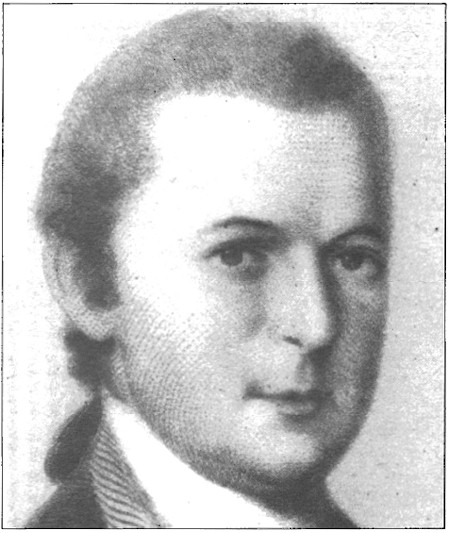
The First Marshal of Pennsylvania Clement Biddle was born into a prosperous Philadelphia family on May 10, 1740. Prior to the Revolution, he worked as a partner in his father John's shipping and importing business.
The troubles with England, however, soon captured his attention. He became an early patriot for the colonial cause. In 1775, Biddle helped raise a company of volunteers in Philadelphia known as the "Quaker Blues". Shortly after the outbreak of the war, on July 8, 1776, the Second Continental Congress commissioned Biddle a deputy quartermaster-general for the Pennsylvania and New York militia. This office carried the rank of Colonel. While serving in this position, Biddle saw action at the battle of Trenton. After the battle, Washington delegated to him the honor of receiving the swords of the surrendering Hessian officers. Later, Biddle fought in the battles of Brandywine, Germantown, and Monmouth. He and his wife also endured the bleak winter of 1777- 1778 with Washington at Valley Forge.
In November 1776, General Nathaniel Greene appointed Biddle his aide-de-camp. The following July, Greene promoted Biddle commissary general in charge of forage, a position he held for three years. In June 1780,Biddle resigned his commission to devote his attention to his neglected business affairs. However, a little over a year later, in September 1781, Biddle ended his retirement from the army at the urgent request of General Greene. He became quartermaster general of the Pennsylvania militia, once again with the rank of Colonel. He remained at this post until the end of the war.
Following the Revolution, Biddle returned to his private interests. He also accepted appointment as Marshal of the Admiralty Courts established during the war by the Continental Congress. These courts were the predecessors of the federal judiciary system established in 1789. Biddle's duties as Marshal of the Admiralty Courts closely resembled those he would have as Marshal of the federal courts. He served court processes, carried out court orders, arrested suspects-mainly pirates and privateers-and sold condemned goods at auction.
Other posts held by Biddle before 1789 included quartermaster of the Pennsylvania militia, notary public, probationary (chief clerk) of the Court of Common Pleas for Philadelphia County, and judge of the same court. In the census of 1790, Biddle listed his occupations as "Notary, Scrivener, and Broker." These various jobs made him a wealthy man. In 1786, for example, he owned almost $3,000 in continental loan certificates.
Biddle enjoyed a close friendship with George Washington. In addition, he handled Washington's business affairs in Philadelphia. Thus, it is not surprising that Washington turned to Biddle to fill the office of Marshal of the Pennsylvania District Court. The new Marshal was 49 when he received his commission.
Unfortunately, the duties of Marshal proved too much for Biddle. In November 1792, Secretary of State Thomas Jefferson asked him to arrest two men who had started a riot in Washington County, Pennsylvania. Jefferson specified that Biddle should make the arrests himself. The Marshal replied that he would like to go after the two men, but he had recently had repeated attacks of gout and was also suffering from "another Complaint which has prevented me from riding any distance on horseback." Although he did not give any additional details on that particular affliction, it must have been some ailment that would make sitting on a bouncing horse uncomfortable. In his stead, Biddle sent his deputy, Captain Jonas Simonds, to make the arrests.
Shortly before the end of his first term. Biddle wrote the President to request that he not be reappointed. He explained that he had hoped that the office of Marshal would be "at some time beneficial to me," but his hopes had gone unrealized. Instead, "the arrangement of the Judiciary System was such as would not compensate the Marshal for the great rescue and hazard that would necessarily attend the Execution of their Duties." Despite this disappointment, Biddle declared that:
I determined, however, to contribute all in my power to the support of the Government of the United States, to execute the Office during the period to which you do me the honor to appoint me and I have endeavored to execute it with fidelity and to merit the Confidence you were pleased to place in me; but I find that the Expense attending the Execution has been equal to or greater than the Endowments of the office and the hazard and Responsibility attending the same and so great that I can not think myself justified in continuing to hold the Office.
Consequently, when his term expired, Biddle returned to private life. In 1794, he accompanied the Pennsylvania militia when it marched on the Whiskey Rebels who had attacked and taken prisoner his successor. During the remainder of his long life, he assumed no other public duties. Biddle died at the age of 74 on July 14, 1814.