



U.S. Marshals Upholding the Constitution
Washington, D.C. is not your ordinary American city and Sunday, October 28, 1990 was not just another ordinary day in the nation's capital. Congress was still trying to finalize the 1991 budget. The White House was considering its response to Saddam Hussein's bellicose rhetoric from the Middle East. And a District Court Judge was granting the Klu Klux Klan permission to march down Constitution.
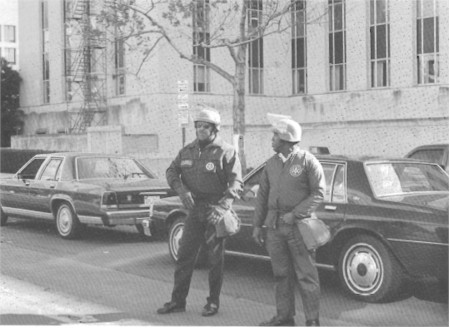
For most Washingtonians, tensions at home and abroad become very common place events and are generally taken very calmly. However, the idea or a Ku Klux Klan march on the city's streets was a different matter. As word of the Klan rally raced through D.C. neighborhoods, local law enforcement officials became concerned and apprehensive.
The issue of granting marching permits to the Klan provoked some interagency tensions among police departments. However, one agency silently kept its vigil on events to come, and prepared for the worst. That agency was the district office of the U.S. Marshals Service.
The court order which permitted the Klan to march was issued at 1 :30 a.m. on Sunday. But for U.S. Marshal Herbert M. Rutherford, III, it came as no surprise. Since he was familiar with past rallies in the city, he also knew that there would probably be counter-demonstrations which would likely bring the potential for violence to the streets of Washington. Using his authority as the top-ranking federal law enforcement official in the city, Rutherford began to coordinate and federalize operations for the rally through the U. S. Marshals Service's Headquarters.
With the immediate approval of senior officials, a major call up of Deputy Marshals was initiated for the District and Superior Courts of Washington, D.C., the Eastern District of Virginia and the District of Maryland to provide supply and logistical support. By 7 a.m.. only five and one-half hours after the Federal district Judge issued his order, the operational command staff had assembled. An hour later, full coordination had begun with the U.S. Park Police and U.S. Capitol Police Intelligence.
By 10 a.m., more than 80 Deputies and administrative personnel had assembled and were receiving their briefings. Because the D.C. Metropolitan Police Department was tasked with primary coverage of the march route, the Marshals had a different mission. Rutherford issued directives for the Marshals to stage as the final protective line for all police departments involved and to seal any breeches that developed in the police lines and make demonstrator arrests.
Some U.S. Marshals were also designated as transportation teams to take arrestees away on large U.S. Marshals Service buses and vans. Additionally, members of the Special Operations Group arrived in a team element to support the rapid deployment of Deputies. Their prompt arrival maintained the Group's reputation for quick response.
All in all, the Marshals Service was able to deploy more than 80 people within three hours of the Klan march and have them fully equipped to provide an enforcement role equal to the other participating police agencies. The Marshals remained involved throughout the demonstration. which eventually resulted in 40 demonstrators being arrested and seven police officers injured, one with a fractured neck.
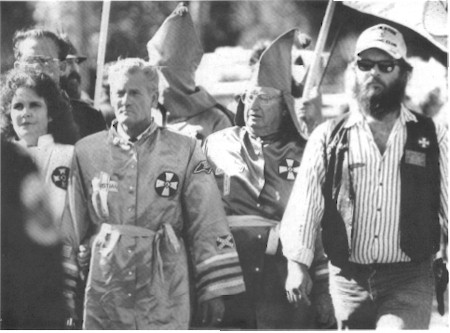
The Klan march in Washington was not a new experience for the Marshals Service. Such civil rights disturbances and crowd control events are part of the Marshals' history - in fact, much of the Service's visibility came from participation in actions to enforce civil rights laws. During these fast paced and rapidly changing days of the 1900's, it appears only a select few remember the tense days of 1962 when U.S. Marshals escorted James Meredith to the University of Mississippi amid strong and dangerous protest.
Meredith was a black American who wanted an education at the college of his choice, which happened to be the University of Mississippi. When a Federal court ordered that Meredith be allowed to register at the University, Deputy marshals enforced the order. Those Marshals were present during the extremely volatile demonstrations and riots that resulted. Though facing constant harassment and assault, they diligently exercised constraint and discipline and still held the line.
Another example of the Marshals involvement in crowd control and civil disturbances took place in 1968. That year widespread rioting. arson, and looting took place in the streets of the District of Columbia. Once again U.S. Marshals were on the scene, making arrests and protecting the citizens of our capital.
And what about the Ku Klux Klan and the streets of Washington D.C.? Will the U.S. Marshals face a similar situation in the future? Probably so. If a return visit does come about, the preparations of law enforcement agencies may be different. In the early 1990's, the U.S. Marshal met with the heads of all participating agencies to discuss new strategies. These included meetings with the Metropolitan Police Department to devise a system to avoid costly court battles with rallying groups, provide adequate protection, and ultimately prevent an excessive financial burden on the taxpayer.